
Between Two Worlds: What Immigrant Parents Wish They Could Say
What I’ve learned from helping immigrant parents and their children navigate two cultures, one breath at a time. By Shirley Wang
Introduction
Since moving back to Los Angeles, I’ve found myself working with the immigrant community in a way I never had before. I’ve always taught a mixture of immigrant families and long-established American families, but something shifted when I returned to L.A. The proximity. The intensity. The unspoken worry.
Suddenly, I wasn’t just a music teacher. I had become a kind of bridge—an interpreter between the Chinese immigrant community and the American education system. I knew this landscape because I had walked it myself: a Taiwanese-born daughter who grew up translating for parents who felt brilliant in their own country and bewildered in this one.
So when an anxious mother was recently referred to me, I recognized the look in her eyes before she even spoke. Exhaustion mixed with hope. Fear disguised as determination. She had heard that a certain arts high school in Southern California had become a quiet obsession among Chinese families—its alumni gaining admission to top universities, its reputation swelling into myth.
She wanted her daughters to have that chance.
She was terrified she might ruin it.
By the time she found me, she wasn’t sleeping. Her hair was graying faster than she could process. She was gaining weight, losing confidence, and drowning in online forums filled with half-truths and overheated rumors. And her daughters, already sensitive and eager to please, had absorbed all of it. They were so anxious they could barely breathe during singing lessons.
The mother didn’t just need vocal training for her children.
She needed guidance.
She needed someone who understood both worlds.
She needed someone who could explain why the school admissions process involved both a placement evaluation and a lottery; why strategy mattered; why the choice of conservatory within the school could shape a young artist’s journey; why none of this guaranteed anything, and yet everything mattered.
In short, she needed what so many immigrant parents need: reassurance that they aren’t failing, even when the system feels like a maze with moving walls.
When she realized that I teach at a sister school—a different county, same model—something in her shoulders finally dropped. For the first time, she felt like she had found someone who could speak to her in a language she understood, even when the conversation was in English.
I have seen this again and again. Families floating in a turbulent sea of rules, rumors, and cultural dissonance—until they find someone who can translate the currents.
The Girl Who Became a Filmmaker
When I teach privately, I often find myself sitting with both the parents and the children—not just as an instructor, but as a mediator. There are moments when I’m teaching vocal technique one minute and explaining an American school email the next. Sometimes I am translating not only language, but fear, misunderstanding, and generational expectation.
One of my students recently discovered a passion for making short films. Like many kids today, she’s fluent in the visual language of social media, and her interest in filmmaking emerged almost effortlessly. We decided she would apply for the Film & Television Conservatory as her second choice at the arts high school. But when I asked what kind of film she wanted to make, she surprised me.
“Maybe a documentary,” she said.
“About what?” I asked.
“About my family. About being immigrants. We’re always confused. We’re always arguing.”
She told me about a simple reminder email her teacher had sent about homework. To her mother—who grew up in China—this was unthinkable. In her experience, a teacher contacted parents only when a child misbehaved or fell behind. She assumed the email was a reprimand. No amount of explaining could undo that assumption. Punishment followed, and confusion deepened on both sides.
Her mother later confessed to me, “I’m constantly confused. I can hardly believe anything my daughter tells me because it just doesn’t make sense. American teachers behave differently. Their logic is different.”
Then she added something that stayed with me:
“I’m grateful for you. You help me understand. You show me they’re trying to help, not shame us.”
In that moment, I felt again how fragile immigrant parenting can be—how easily a simple email becomes a misunderstanding that spirals into shame, fear, or conflict.
We began the documentary with that honesty.
I brought in a friend, a Hollywood director, and together we built a ten-week curriculum: filmmaking basics, genre, storyboarding, call sheets, planning. The student took the lead—writing, organizing, gathering friends to interview. Her parents watched quietly, hesitantly at first, then with amazement as they saw their daughter step into her creativity without fear.
We filmed in their home.
We edited in the director’s studio.
We watched the story shift from conflict to understanding—young immigrants sharing what it feels like to move to America at different ages.
And all this time, we were still working on singing.
The parents, wanting the best, pushed hard. Too hard. Their daughters were so anxious they could barely breathe—impossible conditions for singing, which requires release, trust, and space inside the body. I spent long evenings explaining gently that tension does not create excellence. Breath does. Patience does. Safety does.
By the end of three months, those two sisters—once tight-jawed and fearful—were singing comfortably in Italian, Latin, French, and English. And what they told me surprised me again: singing in languages that were neither English nor Chinese made them feel more at ease.
“In those languages,” one of them said, “we’re on equal footing with everyone else.”
And that, I realized, is the secret heartbeat of so many immigrant households. Everyone is trying so hard to adapt, to succeed, to decode new rules. But in the lesson room—whether through voice, or filmmaking, or a simple conversation—there is finally space where no one has to pretend they already know how to belong.
What Immigrant Parents Often Misunderstand
Many immigrant parents struggle to believe that American education really functions the way it does. They come from systems rooted in uniformity, rigor, and high-stakes testing. But here, the system is built on a philosophy of freedom and individuality. Students are encouraged to form opinions, explore interests, and take risks. For rule-followers, this can feel impossible to trust.
What American Educators Often Misunderstand
From the outside, immigrant parents may appear pushy, overly strict, or uninterested in individuality. But beneath that exterior is a very different story.
In many Asian countries, education isn’t just important—it is the single gateway to a stable future. Competition is fierce, and higher education opportunities are scarce compared to the number of students. Test scores are everything because schools have no other way to differentiate applicants.
In the U.S., success looks different. Top schools want thought leaders, not test-taking machines. Immigrant parents aren’t always aware of that. They push not because they don’t care about emotional well-being, but because they don’t understand the American system—or trust it yet. Their urgency comes from love mixed with fear.
Children Between Two Cultures
Children growing up between cultures often carry an emotional load adults don’t see. Their roles shift constantly. At home, they are mediators, translators, peacekeepers. At school, they are expected to embody independence and individuality. The messages they receive from parents and teachers often conflict. Their lives become a Venn diagram of overlapping, contradictory expectations.
And still, they try their best to please everyone.
Where the Arts Come In
American arts education offers something many immigrant children desperately need: freedom.
Freedom to breathe.
Freedom to explore.
Freedom to create something that feels like their own.
Singing requires release. Breath. A body that is allowed to relax. Filmmaking asks a young person to transform a thought into something real. Creative work invites imagination, not imitation. These are not luxuries. For many children, they are lifelines—spaces where they are not required to perform perfection, only to show up honestly.
The arts are also therapeutic. They bring joy, calm, and curiosity back into a life often burdened by pressure. And parents, seeing this, begin to understand that creativity is not a distraction from success. It is part of it.
What Teaching Has Taught Me
Underneath everything, this work has taught me to lead with compassion. To see each family as human first, not as a list of misunderstandings or anxieties. To listen without assumptions. To recognize that my job is not simply to teach singing or prepare applications—it is to build an environment where children can grow.
I’ve become more reflective, more careful, more aware of the power an educator holds. I’ve learned not to assume I know everything. I’ve learned I will make mistakes too. And I’ve developed a deeper understanding of my own family—my parents, my siblings, the trickle-down effects of immigration that shape all of us in ways we don’t always see.
If I could say one sentence to every immigrant parent, it would be this:
You’re doing better than you think, and your love for your children will help you to always end up making the right decision.
A Memory, and a Promise
Sometimes, when I’m helping a parent untangle a school email or encouraging a child to take their first full breath, I see a younger version of myself in both of them.
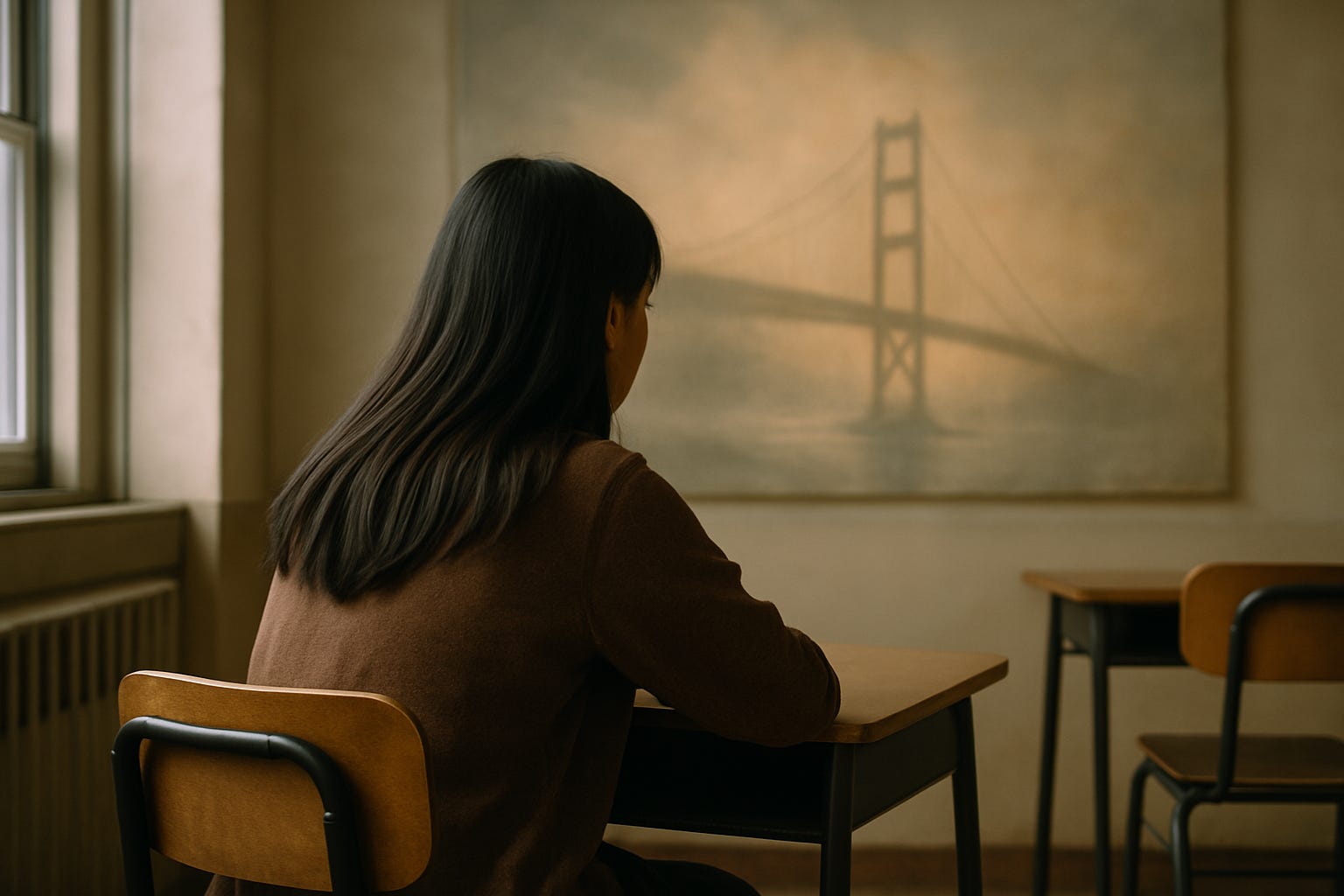
I see the fifteen-year-old hunched over a tiny desk in an empty classroom, shaking through her English placement exam while her parents waited helplessly outside.
I see the teenager who filled out her own college applications with a dictionary.
I see the girl who taught piano to help her family survive, who lived at the mercy of strangers who offered free lessons out of kindness.
Who would have known that, decades later, that same child would thrive?
Who would have imagined she’d graduate from top music schools, build a career in the arts, and guide other immigrant families across the bridges she once had to build alone?
If I could reach back in time, I would tell her: It’s going to be okay.
And I would tell every immigrant parent and child the same thing.
The path may feel unpredictable. The fears may feel heavy.
But we can all pause, just for a moment, and exhale.
Everything turns out to be okay.
Author’s Note / About My Work
As my work with immigrant families has deepened, my studio has grown beyond traditional private lessons. In addition to vocal and artistic instruction, I now offer a full consultative service designed to support families navigating the American education system—especially those applying to arts-focused middle and high schools. This includes guidance on placement activities, audition preparation, conservatory selection, educational planning, and the cultural nuances that shape a child’s learning environment. My goal is simple: to create a bridge of understanding where children can thrive, parents can breathe, and families can move forward with clarity and confidence.
If you’d like to learn more about these services or how we can work together, feel free to reach out.
Bless you for the work you are doing, including helping other teachers understand the perspectives of immigrant parents and students. This was a beautiful piece to read.